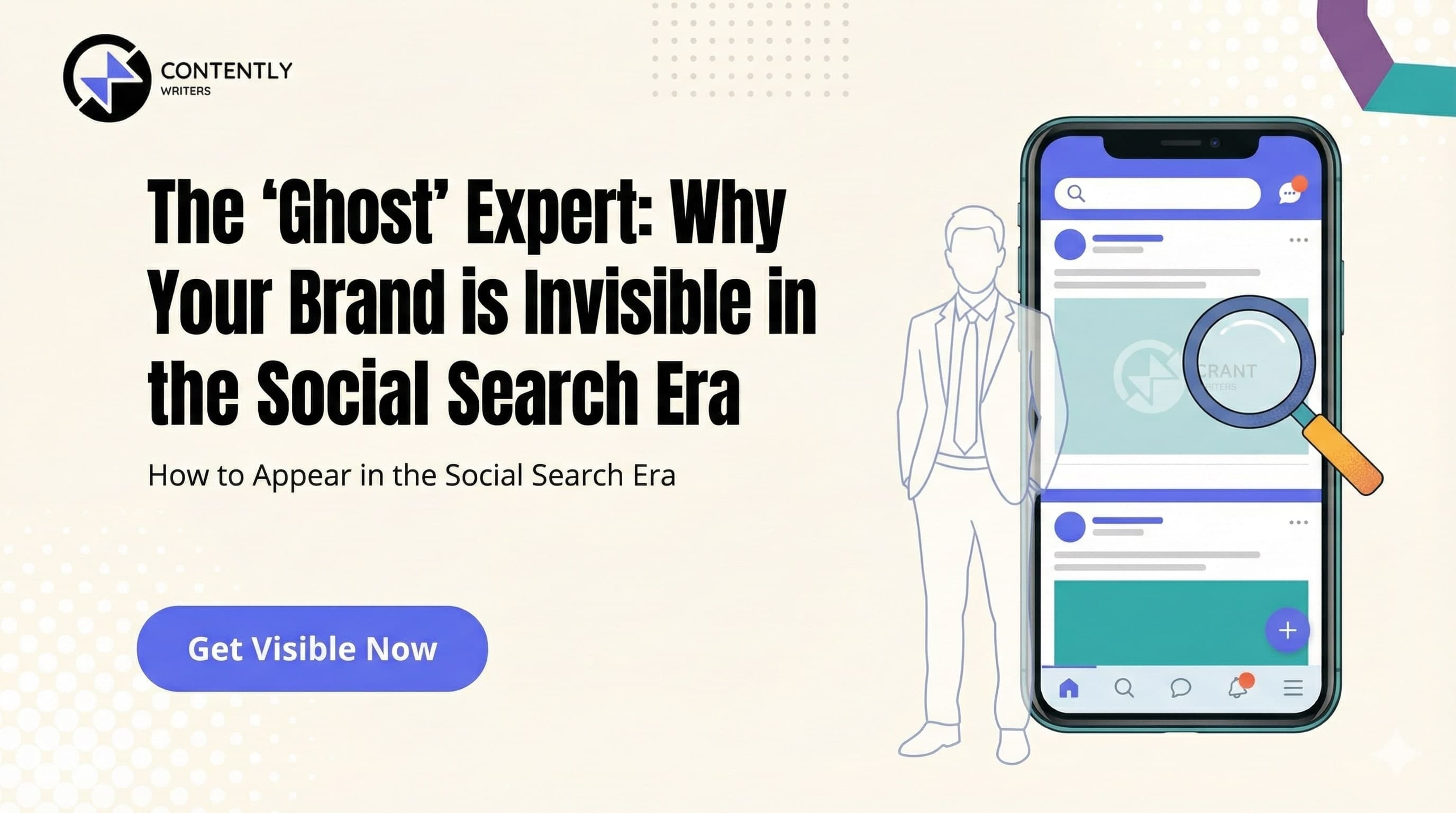
The Ghost Expert: Why You're Invisible in Social Search
Last Tuesday, I Googled my own name.
I know, I know. Vanity metric at its finest. But hear me out, because what I found made me question everything I thought I knew about building a personal brand in 2026.
My LinkedIn profile? Nowhere on the first page. Not even close.
Instead, there was some random comment I'd left on a Reddit thread three years ago, a half-baked Medium article I'd completely forgotten about, and most embarrassingly, someone else with my exact name who apparently runs a successful dog grooming business in Nebraska.
I had been posting consistently on LinkedIn for eight months. I had credentials. I had experience. I had thoughts, dammit. And yet, to the world searching for expertise in my field, I was a ghost.
The Moment Everything Changed
Here's what really stung: A potential client later told me they'd tried to "research me" before our call. They found nothing substantial. So they went with someone else whose LinkedIn profile actually showed up when they searched for solutions to their problem.
I wasn't losing opportunities because I lacked expertise. I was losing them because I was invisible.
And if you're reading this, there's a decent chance you're a ghost too.
The Hard Truth About Personal Branding in 2026
Let me be brutally honest about something most LinkedIn coaches won't tell you: Personal branding isn't just about posting three times a week anymore. It never really was, but now? The game has fundamentally changed.
We've entered what I call the "social search era." People don't just scroll and hope to find you. They actively search for solutions, and if your profile isn't optimized for those searches, you simply don't exist.
Social search is the new traffic: Most people are still waiting for Google to save them, but the real goldmine has shifted to where the conversations actually happen. Think about the last time YOU needed to hire someone or solve a business problem. Did you scroll through your feed hoping the right expert would magically appear? Or did you search "fractional CFO for SaaS startups" or "LinkedIn strategy consultant for B2B"?
Exactly.
Your potential clients are doing the same thing. And right now, they're finding everyone but you.
Why Being Authentic Isn't Enough Anymore
I used to think authenticity was the golden ticket. Just be myself, share my journey, and post what feels right. And sure, that's still important. But authenticity without visibility is just shouting into the void with slightly better grammar.
The uncomfortable reality is that there are probably dozens, maybe hundreds, of people with similar expertise to yours. Some might even be less experienced or less qualified. But if they show up in search results and you don't, guess who gets the opportunity?
This isn't about being the best. It's about being found first.
The Three Ghosts Haunting Your LinkedIn Profile
After my ego-crushing Google search, I became obsessed with understanding why some experts dominate social search while others remain invisible. I analyzed hundreds of profiles, talked to people who actually get found, and ran embarrassing amounts of experiments on my own profile.
I discovered that most "ghost experts" are haunted by three specific problems:
Ghost #1: The Generic Bio
Your LinkedIn headline probably says something like "Marketing Professional | Helping Businesses Grow | Passionate About Innovation. "
Cool. So do 47,000 other people.
When someone searches for a specific solution, LinkedIn's algorithm doesn't reward vagueness. It rewards specificity. The person who writes "B2B SaaS Growth Strategist | Scaling ARR from $1M to $10M | Former VP at [Recognizable Company] " will show up. You won't.
I learned this the hard way when I changed my headline from "Digital Marketing Expert " to something that actually described the specific transformation I create for clients. My profile views tripled in two weeks.
Ghost #2: The Content Desert
Here's a question that made me uncomfortable: If someone lands on your LinkedIn profile right now, would they immediately understand what you know and why you're worth listening to?
For most people, the answer is no because their profile is a glorified resume, not a trust-building machine.
Trust is the new traffic: In an AI-cluttered world, your 'reach' doesn't matter if nobody believes you. Here is how to turn skepticism into your biggest competitive advantage.
Your Featured section is empty. Your About section reads like a cover letter from 2015. You haven't posted anything in three weeks, and when you did, it was a recycled motivational quote with a stock photo.
Meanwhile, the experts who dominate social search have profiles that scream authority. Case studies in the Featured section. Client testimonials. Original insights that demonstrate thought leadership. Proof that they're not just talking about the expertise, they're actively using it.
Ghost #3: The SEO Blindspot
This is the one that crushed me the most: I had been treating LinkedIn like a social network when I should have been treating it like a search engine.
Google indexes LinkedIn profiles. LinkedIn has its own internal search. And both systems are looking for the same signals: relevant keywords, consistent terminology, proof of expertise, and engagement metrics.
But I had been writing for humans, not for algorithms. Which sounds noble until you realize that algorithms decide whether humans ever see your content in the first place.
The experts who get found understand something crucial: You can write for both. You just have to be intentional about it.
The Day I Stopped Being a Ghost
I'll never forget the first time someone found me through a search instead of through my network.
She sent me a message that started with: "I Googled 'LinkedIn consultant for tech executives,' and your profile came up third. I've read through your posts, and you clearly understand the challenges I'm facing."
Third. Not first, but third. And that was enough to start a conversation that turned into a five-figure contract.
That's when it hit me: Every single person I'd been trying to reach through clever hooks and viral posts was one search query away from finding me. I just had to make sure I showed up when they looked.
What Actually Works (Without the Cringe)
Look, I get it. The idea of "optimizing your profile for SEO" sounds about as appealing as wearing a sandwich board that says "HIRE ME." It feels desperate. It feels inauthentic.
However, I realized that optimization isn't about gaming the system. It's about making sure the right people can find you when they need exactly what you offer.
Here's what actually moved the needle for me:
I rewrote my headline to include the specific keywords my ideal clients were searching for. Not generic buzzwords. Actual search terms. The difference between "Marketing Leader" and "Demand Generation Director for B2B SaaS | $50M+ Pipeline Created" is the difference between invisible and discoverable.
I treated my About section like a mini-website. I structured it with subheadings (yes, LinkedIn supports those now). I included specific outcomes. I told a story, but I also made sure that the story contained the exact terminology someone would use when searching for my expertise.
I audited every piece of content through two lenses: Does this demonstrate authority, and does it include searchable language? I stopped posting random thoughts and started creating content that would still be valuable six months from now. How-to guides. Frameworks. Contrarian takes backed by data.
I filled my Featured section with proof. Case studies. Published articles. Speaking engagements. Testimonials formatted as images (because LinkedIn's algorithm loves native uploads). Anything that would make someone think "This person isn't just talking, they're doing."
I started treating my profile like a living document. I update it quarterly. I add new skills as I develop them. I refresh content based on what's working. Because the algorithm rewards active profiles over abandoned ones.
None of this felt "cringy" once I reframed it. I wasn't trying to trick anyone. I was making it easier for the right people to find me when they needed help.
The Question That Changes Everything
Here's the question I now ask myself before posting anything or updating my profile:
"If someone searched for a solution to this exact problem in six months, would this content help them find me?"
If the answer is no, I either don't post it or I restructure it so the answer becomes yes.
This single shift transformed my LinkedIn presence from a personal diary into a client acquisition engine.
Why AI Makes This More Important, Not Less
I know what you're thinking. With AI churning out content at scale, doesn't personal branding become even harder?
Actually, it's the opposite.
AI has made generic content worthless. Anyone can generate a decent LinkedIn post about leadership or productivity in 30 seconds now. Which means the only content that matters is the content that could only come from you.
Your specific client stories. Your contrarian opinions are based on real experience. Your frameworks were developed through trial and error. Your face. Your voice. Your proof.
The strangers who find you through search aren't looking for another AI-generated post about a growth mindset. They're looking for a human being they can trust with their actual problem.
But they can only trust you if they can find you first.
The Real ROI of Being Findable
Three months after I stopped being a ghost, something unexpected happened.
A founder reached out who'd found me through a Google search for "LinkedIn strategy for technical founders." We'd never met. We had no mutual connections. He wasn't even in my target industry.
But he'd been searching for someone who understood the unique challenges of introverted, technically-minded leaders trying to build a personal brand without feeling like a phony. And my profile showed up because I'd written extensively about exactly that.
That one connection led to a retainer client, three referrals, and a speaking opportunity at a conference I'd been trying to get into for two years.
None of that happens if I'm a ghost.
Is Personal Branding Even Worth It Anymore?
Here's my honest answer: Personal branding was never worth it. Not the way most people teach it.
Building a "personal brand" for the sake of having one? Posting three times a week because a coach said you should? Obsessing over vanity metrics like followers and likes?
Waste of time.
But building a discoverable presence that helps the right strangers find you when they're actively searching for your expertise? That's not personal branding. That's just smart business.
The difference is intent. Are you posting to feel productive, or are you creating assets that compound in value over time?
Are you optimizing for applause or for being found?
The Unglamorous Truth
Nobody talks about this part, but building social search visibility is boring work.
It's keyword research. Profile audits. Content restructuring. Consistency over months, not days. It's treating your LinkedIn profile like a product launch instead of a digital business card.
It's not sexy. It won't go viral. There's no hack.
But six months from now, when a stranger becomes a client because they found you through a search, you'll understand why the ghosts stay ghosts.
They're waiting for a shortcut that doesn't exist. Meanwhile, the experts who are found are doing the boring work that compounds.
How to Stop Being a Ghost (Starting Today)
If you take nothing else from this, take this:
Google yourself. Right now. See what shows up. That's what your potential clients see when they try to verify you're legit.
Then Google the problem you solve plus "LinkedIn" or "consultant" or "expert." See who shows up. Study their profiles. Notice what they're doing differently.
Finally, ask yourself: If someone needed exactly what I offer and searched for it today, would they find me?
If the answer is no, you're not failing at personal branding. You're just invisible. And invisibility isn't a character flaw; it's a technical problem with a technical solution.
You're not a bad expert. You're just a ghost.
And ghosts, as it turns out, can become very real very quickly. You just have to decide you're done haunting the margins and ready to be found.
Now that I've been found, why should they listen to me specifically instead of a generic AI-written post?
Because I was a ghost too. And I know exactly what it feels like to have expertise that nobody can find.
The difference is, I'm not a ghost anymore.
And after reading this, you don't have to be either.
If you’re ready to stop haunting the margins but don’t have the 10+ hours a week to do the "boring work" yourself, let’s talk. We’ve built the best content writing company specifically for experts who need to be found without losing their voice to the AI void.